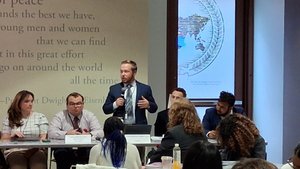
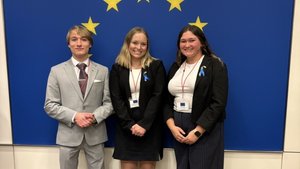
John Carroll University students traveled to Washington, D.C. this fall as part of a European Union Simulation course that blends diplomacy, international politics, and hands-on learning. The class, taught by Dr. Andreas Sobisch, brings together students from a range of majors to study European institutions before stepping directly into the roles of EU leaders, diplomats, and policymakers.
The course culminates in participation in the Mid-Atlantic European Union Simulation Consortium (MEUSC), a collaboration of eight colleges and universities that provides students with an immersive, real-world policy experience.
Learning Diplomacy Where It Happens
This year marked John Carroll’s 26th consecutive year participating in MEUSC. From November 12 through November 16, 2025, students traveled to Washington, D.C., where they represented Finland, Estonia, and Croatia during the simulation. Each student assumed the role of a specific policymaker, conducting extensive research throughout the semester to accurately portray their “alter ego.”
“The purpose of a political science simulation (or, really, any simulation) is to replicate, albeit in simplified and abbreviated form, the decision-making process of an institution (or set of institutions) in order to better understand how this process works in real life. Through role playing students learn about the factors and forces that shape the behavior of political leaders in the real world.”
For many students, the simulation offered a deeper and more dynamic understanding of European politics than traditional coursework alone.
“We had to write papers and create presentations in class on the workings of the EU and on the country and people that we represented,” said Max Nadeau ’27. “This made sure that you understood the institutions that you were a part of and how your alter ego would react to situations and issues which came up during the simulation. The simulation itself proved as a better test of what we’ve learned than any traditional exam or paper ever could.”
Nadeau was recognized with the award for Best Prime Minister in the European Council, for his role as Kristen Michal, Prime Minister of Estonia.
Experiential Learning in Our Nation’s Capital
Beyond the simulation, students visited multiple embassies and met with professionals working in European policy and international relations, offering firsthand insight into how EU decisions affect global diplomacy.
“We visited Embassy Row and spoke with the Estonian Ambassador, as well as two members of the EU Delegation in the U.S. and a few policy staff at the Finnish Embassy,” said Isabella Hunter ’27. “We were able to ask the Estonian Ambassador questions about any topic that related to geopolitics and the EU. Hearing from someone directly impacted by EU laws helped shape my experience because it put into perspective that these issues are being debated in real time.”
Students shared that the course strengthened a wide range of transferable skills, from public speaking and negotiation to research and collaboration. The simulation also offered valuable networking opportunities, allowing students to engage with international leaders and work alongside peers from institutions across the country.