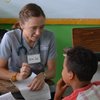
From local neighborhoods to remote medical clinics in Honduras, John Carroll University students are learning that health is about more than treating illness—it’s about understanding people, communities, and the systems that support them.
John Carroll’s new Public Health major, launched last year, builds on this foundation. It takes an interdisciplinary approach, combining courses in biology, exercise science, economics, political science, psychology, and sociology to equip students with the knowledge and perspective to improve health outcomes at both individual and population levels.
“We’re so excited to have launched our new public health major, and it’s been great to see how much student interest it’s already generating,” said Dr. Erin Johnson, Director of Public Health and Professor of Biology at John Carroll. “The program really reflects John Carroll’s Jesuit values, especially our focus on educating the whole person and serving others. Through an interdisciplinary approach, students learn to tackle today’s most pressing health challenges with ethical leadership, all with a focus on promoting the common good.”
According to the U.S. Bureau of Labor Statistics, employment in public health–related fields is expected to grow by 15-30% in the next decade, as the demand for skilled professionals continues to rise in the wake of the COVID-19 pandemic.
“I learned about JCU’s Public Health major my junior year and I was immediately interested,” shared Cassie Klein ’26, a senior Public Health major and soon-to-be first graduate of the program. “Public Health helped me see how systems, structures, and policy shape lives. Each class reinforces that society can be improved and that compassion and equity must guide our actions. This experience is reinforcing my calling to serve others and contribute to something larger than myself.”
Learning to Care for Communities in Need
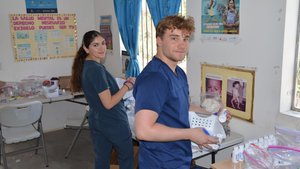
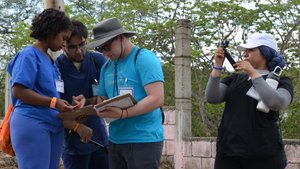
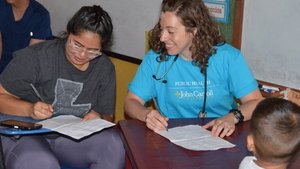
One of the most powerful real-world experiences for public health students, and other health science majors at John Carroll, is the university’s annual spring immersion trip to Honduras. During this week-long experience, students and faculty work in rural villages where they help set up medical clinics that serve between 200 and 300 people each day.
The immersion requires students to engage both physically and emotionally with the realities of poverty and health disparities in a country where 52 percent of the population lives on less than $6.85 U.S. dollars per day. It is an opportunity to witness the structural barriers communities face and to understand the importance of culturally responsive, community-centered care.
Access to potable water remains one of Honduras’s most urgent public health challenges. Through a long-standing partnership with Mission Honduras, JCU students distribute water filters to households in need, helping reduce illness and improve daily life. Providing clean water supports not only better health outcomes, but also education, economic stability, and human dignity, all of which reflect the mission and values that guide a John Carroll education.
“Studying public health has given me a broader understanding of how science impacts people’s lives beyond the classroom. It’s about seeing health on a larger scale; how prevention, education, and access to resources can strengthen entire communities,” said Bailey Parsons ’26, a Cell and Molecular Biology major and Public Health minor at John Carroll. “My immersion trip to Honduras showed me just how powerful public health efforts can be in creating real, lasting change. For anyone interested in medicine, science, or service, public health is an incredible way to connect your studies to meaningful action in the world.”
JCU Alumni Shaping the Future of Public Health
The lessons learned in places like rural Honduras do not end when JCU students return to campus. They continue to shape the perspectives and careers of graduates who carry these values into their work in communities across the country and around the world.
For Dr. Elizabeth Pawlowski ’14, public health is not just a professional interest, it’s central to her daily practice as a Primary Care Provider at a Federally Qualified Health Center (FQHC) in Tucson, Arizona.
“I was excited to learn that JCU is incorporating Public Health into its curriculum,” said Dr. Pawlowski. “In my current role, we serve a predominantly uninsured and underinsured Hispanic and refugee population. Public health plays an integral role in my daily practice, as I care for individuals and families from diverse global backgrounds.”
Similarly, Dr. Emily Herfel ’12, an Obstetrician-Gynecologist with Duke University and Director of the OBGYN Residents’ Global Elective, sees public health as inseparable from patient care.
“Every day, both in the U.S. and abroad, my clinical care involves public health and advocacy,” said Dr. Herfel. “Every patient encounter is influenced by broader public health systems, from gynecologic cancer screenings and health education to environmental conditions and access to care. My osteopathic clinical training taught me to see the patient holistically, and an understanding of public health enables me to consider the bigger picture: preventing illness before it starts, addressing structural barriers to wellness, and promoting health equity.”
As John Carroll continues to expand its programs in health and wellness, these experiences, rooted in cura personalis, or care for the whole person, are preparing students to serve others with knowledge, empathy, and purpose.