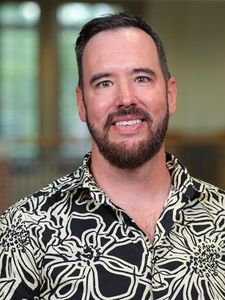
James Watling
Associate Professor/Coburn Chair
Background
Environmental scientist and project leader with 15+ years of experience managing cross-functional teams, designing and analyzing large-scale ecological datasets, and delivering actionable insights to stakeholders across academic, governmental, and non-profit sectors. Proven track record of securing competitive funding ($1.5M+), advising policy-relevant environmental modeling efforts, and leading GIS, remote sensing, and climate impact analysis projects. Bilingual (English/Spanish). Fulbright Specialist with international project coordination experience. Experienced department chair and program developer with a commitment to equity and inclusion.
Areas of Expertise
- Conservation Biology
- Landscape Ecology
- Climate Change
- Geographic Information Systems
Research Interests
In our lab, we use observational, experimental, and geospatial modeling approaches to understand how drivers of global change such as landscape modification and climate change impact species and the landscapes in which they occur. My students and I do fieldwork in the United States and South America, working with a network of graduate students and undergraduate collaborators, technicians, and researchers from the federal government. Please check out this video about recent work in the lab!
Education
BA, Environmental Science, Boston University
MS, Biological Sciences, Florida International University
PhD, Biological Sciences, Florida International University
Courses Taught
- BL 1700, Principles of Biology III
- BL 2220, General Ecology
- BL 3310, Global Climate Change
- BL 4170/5170, Introduction to Geographic Information Systems
- BL 4190/5190, Conservation Biology
- PH 1150, Environmental Earth Science
Publications
†graduate student author **undergraduate author†Saboyá Acosta LP, Watling JI, Urbina-Cardona JN (2025) Heterogeneity does matter:
estimating relationships between anuran diversity and the environment at different spatial scales in
a protected páramo of Colombia. Landscape Ecology 40:98.
Flinn KM, **Litwinowicz Z, Mahany TP, Watling JI. (2025) Presettlement tree distributions
and forest types in northeast Ohio, USA, mapped with species distribution models. Journal of
Vegetation Science e70007.
Nowakowski AJ, Watling JI, Murray A, Deichman JL, Akre TS, Muñoz Brenes CL, Todd BD,
McRae L, Freeman R, Frishkoff LO. (2023) Protected areas slow declines unevenly across the
tetrapod tree of life. Nature 622:101-106.
†Veselka AJ, †Aponte-Gutiérrez A, †Medina-Baez OA, Watling JI (2023) Upper thermal limits
predict herpetofaunal responses to forest edge and cover. Biotropica 55:540-550.
Fahrig L, Watling JI, Arnillas CA, Arroyo-Rodríguez V, Jörger-Hickfang T, Müller J, Pereira
HM, Riva F, Rösch V, Seibold S, Tscharntke T, May F (2022) Resolving the SLOSS dilemma for
biodiversity conservation: a research agenda. Biological Reviews 97:99-114.
Arroyo-Rodríguez V, Fahrig L, Tabarelli M, Watling JI, Tischendorf L, Benchimol M, Cazetta E,
Faria D, Leal I, Melo FPL, Morante-Filho JC, Santos BA, Arasa-Gisbert R, Arce-Peña N,
Cervantes-López MJ, Cudney-Valenzuela S, Galán Acedo C, San-José M, Vieira ICG, Ferry Slick
JW, Nowakowski AJ, Tscharntke T (2020) Designing optimal human-modified landscapes for
forest biodiversity conservation. Ecology Letters 23:1404-4020.
Costanza, JK, Watling JI, Sutherland R, Belyea C, Dilkina B, Cayton H, Bucklin D, Romañach
SS, Haddad NM (2020) Preserving connectivity under climate and land-use change: no
one-size-fits-all approach for focal species in similar habitat. Biological Conservation 248:108678.
Watling JI, Arroyo-Rodríguez V, Pfeifer M, Banks-Leite C, Cisneros LM, Fang R, Lander B, Leal
IR, Lens L, Possingham HP, Raheem DC, Ribeiro DB, Slade EM, Urbina-Cardona JN, Wood EM, Fahrig L (2020)
Support for the habitat amount hypothesis from a global synthesis of species
density studies. Ecology Letters 23:674-681.
Betts MG, Wolf C, Pfeifer M, Banks-Leite C, Arroyo-Rodríguez V, Ribeiro DB, Barlow J,
Eigenbrod F, Faria D, Fletcher RJ Jr, Hadley AS, Hawes JE, Holt RD, Klingbeil B, Kormann U,
Lens L, Levi T, Medina-Rangel GF, Mezger D, Morante-Filho JC, Orme D, Peres CA, Phalan BT,
Pidgeon A, Possingham H, Ripple WJ, Slade EM, Somarriba E, Tobias J, Tylianakis JM,
Urbina-Cardona JN, Valente JJ, Watling JI, Wells K, Wearn OR, Wood E, Young R, Ewers
RM (2019) Extinction filters mediate the global effects of fragmentation on animals. Science 366:
1236-1239.
Fahrig L, Arroyo-Rodríguez V, Bennett JR, Boucher-Lalonde-V, Cazetta E, Currie DJ, Eignbrod
F, Ford AT, Harrison SP, Jaeger JAG, Koper N, Martin AE, Martin J-L, Metzger JP, Morrison P,
Rhodes JR, Saunders DA, Simberloff D, Smith AC, Tischendorf L, Vellend M, Watling JI
(2019) Is habitat fragmentation bad for biodiversity? Biological Conservation 230:179–186
Nowakowski AJ, Watling JI, Thompson ME, Brusch IV GA, Catenazzi A, Whitfield SM, Kurz
DJ, Suárez-Mayorga Á, Aponte-Gutiérrez A, Donnelly MA, Todd BD (2018) Thermal biology
mediates responses of amphibians and reptiles to habitat modification. Ecology Letters 21:345-355.
Pfeifer M, Lefebvre V, Peres CA, Banks-Leite C, Wearn OR, Marsh CJ, Mutchart SHM,
Arroyo-Rodríguez V, Barlow J, Cerezo A, Cisneros L, D-Cruze N, Faria D, Hadley A, Harris S,
Klingbeil BT, Kormann U, Lens L, Medina-Rangel GF, Morante-Filho JC, Olivier P, Peters S,
Pidgeon A, Ribeiro DB, Scherber C, Schneider-Maunory L, Struebig M, Urbina-Cardona N,
Watling JI, Willig MR, Woods EM, Ewers RM (2017) Creation of forest edges has a global
impact on forest vertebrates. Nature 551:187-191.