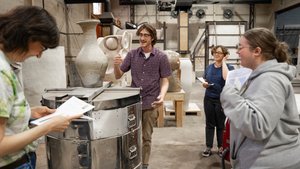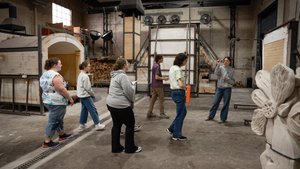
This March, John Carroll University chemistry students traded their lab benches for a working artist studio, stepping inside DISPEL Institute — the public-facing educational arm of Alexander Demetriou Studio — for an immersive workshop titled Transformation of Materials.
Alexander Demetriou Studio is the Cleveland-based practice of sculptor Alex Demetriou, whose large-scale ceramic work explores the reciprocity between material, fire, and form. Founded in 2021, DISPEL Institute extends the studio's mission through internships, residency opportunities, private workshops, and events for those interested in hands-on learning in sculpting, glaze chemistry, kiln maintenance, and atmospheric firing. The studio features some of the largest privately owned kilns in the country and teaches students about the art of monumental ceramics.
Hosted at Alexander Demetriou Studio's facility in Cleveland, John Carroll students participated in a two-hour experience exploring the scientific principles behind large-scale ceramic sculpture. Led by DISPEL staff, Bryce Boynton, Director of Sculptural Fabrication and Studio Mechanics, and Jane Gregory, Studio Ceramicist and Director of Studio Practice, the session educated students about the chemical processes involved in ceramics.
“Connecting our studies of atomic properties to the physical transformations seen at DISPEL Institute was an incredible experience for our students. There is something truly amazing about touching and feeling the results of the heat and energy transfers we study in classes and labs. It was a lovely opportunity to engage with our students in a setting where chemistry and art so clearly intersect.”
In learning about the controlled rise in temperature of ceramic work within a kiln, the students connected chemistry classroom concepts to the clay body and glazes that are transformed from raw materials into the artistic outcomes visible in ceramic sculpture.
"Ceramics lives at the intersection of art and material science," said Demetriou. "As students walk through the studio, I encourage them to look closely, especially at the glazes. Look at where they pool, where they thin and break over edges, where fire and atmosphere alter their color. These surfaces are records of reactions — geological events compressed into a few days of heat. To me, sculpture isn't about imposing form onto matter. It's about entering into a reciprocity with it."
Students asked questions throughout the session, engaging in discussion about kiln temperatures and how small compositional changes can produce dramatically different results.
"It was really interesting to learn about the firing process since that is where a lot of the chemistry of ceramics comes into play," said Lauren Salata '27. "While the artist throws the pottery and decides what shape it is going to be, firing determines the color, texture, and so many other things. As a chemistry major who also likes to create things, going to DISPEL Institute was an eye-opening experience about how my two passions can be combined."
The visit reinforced John Carroll's commitment to experiential learning, offering chemistry students a vivid reminder that chemical transformation is not confined to textbooks or laboratory experiments. To learn more about Alexander Demetriou Studio and DISPEL Institute, visit demetrioustudio.com