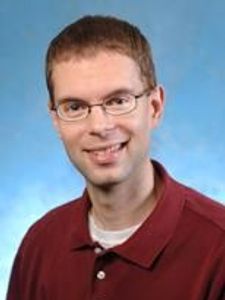
Dr. Colin Swearingen
Professor/Chair
Background
Dr. Colin Swearingen graduated from Grove City College with a B.A. in Political Science in 2005. In 2010, he received his M.A. and later his Ph.D. in Political Science from the University of Oklahoma. He is currently a Professor of Political Science. A native of northeast Ohio, he is a long-suffering Browns fan.
Areas of Expertise
Dr. Swearingen is widely published on US elections as well as public health in rural Honduras. His research on elections focuses on congressional and presidential contests, and specifically the role that public attention and social networking play in affecting outcomes. His public health research is rooted in his decade-plus experience of leading the JCU Honduras Public Health Immersion and focuses on clean water interventions, local government decision-making, and household characteristics.
Research Interests
“Isolation and Infrastructure: How Geography Affects Water System Performance in Rural Honduras.” With Rafaella Di Cesaro. Revise & resubmit at Water Security.
“What Happened to Our Water? Decentralization and Deliberative Democracy in Rural Honduran Water Boards.” With Rafaella Di Cesaro and Dany Diaz.
“Who Gets the Grade? Geography and Water Service Provider Quality in Rural Honduras.” With Naya Alsouss, Dany Diaz, Rafaella Di Cesaro, Serine Jaffal, Laila Julien, Maria Julien, Veronica Mekhel, Maide Seyhan, and Kathryn Vasiliauskas.
Education
Ph.D., M.A., University of Oklahoma; B.A., Grove City College
Courses Taught
- Introduction to US Politics
- Political Statistics & Analysis
- Healthcare Access in Latin America
- US Congress
- US Elections
- American Presidency
- Cuba: Past & Present
- Politics & Mapping
Publications
“Efficacy of Water Filters and Training Interventions in Mitigating Gastrointestinal Symptoms in Rural Honduras.” With Naya Alsouss, Marko Babic, Jacob Clark, Christian Dwyer, Chase Hudock, Laila Julien, Patrick McGraw, Rebecca Mekhel, Veronica Mekhel, Shubham Patel, Vladimir Tchepak, Mia Urbani, and Kathryn Vasiliauskas. Water Practice & Technology 20 (2), 2025.
“Where’d You Go, Ohio: Progressive Ohio Ballot Initiative Passage in a Republican-Aligned State.” With Dr. Elizabeth Stiles and Barrett Scheatzle. Journal of Economics & Politics 29 (1), 2025.
“Linked Together: The Benefits of Integrative Teaching in the Liberal Arts.” With Gloria Vaquera, John McBratney, and Maria Marsilli. The Teaching Professor, 2024.
“Life of the Party: Social Networks, Public Attention, and the Presidential Nomination Process.” With Elizabeth Stiles and Linda Seiter. Social Science Computer Review, 2022.
“A Battleground No More: Cosmopolitanism, the Culture Wars, and the Urban-Rural Divide in Ohio Elections, 2004-2020.” With TJ Lindstrom. Journal of Economics and Politics 26 (1), 2021.
“Catch Me if You Can: Using a Threshold Model to Simulate Support for Presidential Candidates in the Invisible Primary.” With Elizabeth Stiles, Linda Seiter, and Brendan Foreman. Journal of Artificial Societies and Social Simulation 23 (1), 2020.
“The Impact of Presidential Field Offices in Ohio, 2008-2012” Journal of Economics and Politics 24, 1, 2018, pp. 20-42.
“Google Insights and U.S. Senate Elections: Does Search Traffic Provide a Valid Measure of Public Attention to Political Candidates?” Social Science Quarterly 95, 3 (September), 2014, pp. 882-893. With Joseph T. Ripberger.
“Is Timing Everything: Retirement and Seat Maintenance in the U.S. House of Representatives”, Legislative Studies Quarterly 36, 2 (May), 2011, pp. 309-330. With Walt Jatkowski, III.
“District of Columbia,” in Donald P. Haider-Markel ed., Political Encyclopedia of U.S. States and Regions, CQ Press, 2008.