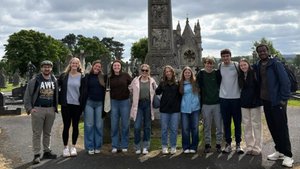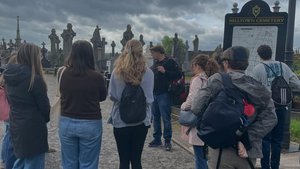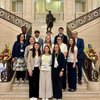
Since 2011, Dr. Philip Metres, Director of the Peace, Justice, and Human Rights program and Professor of English at John Carroll, has led students to Ireland to study the Troubles, the decades-long conflict between Irish nationalists and British unionists that shaped the region’s history and identity.
This summer, John Carroll students joined Dr. Metres for a two-week immersive experience, where they encountered the culture, geography, stories, art, history, and lives of those who survived the traumatic conflict—many of whom now work actively for peace and justice.
“Because Northern Ireland is a sort of living laboratory for conflict transformation, and is relatively close in culture and language to our own, it’s an ideal place to test the theories of the moral imagination and see how the people approach their complex reality,” said Dr. Metres. “The dominant story of Northern Ireland, for twenty-five years, has been peace and reconciliation. There are other stories to tell there, to be sure. But the fact that we’re still listening means that their story is validated, and those who carry the painful burdens of the past can share them with us, and perhaps be energized to continue to carry themselves into a new future.”
Before departing for Ireland, students take a spring semester course on Irish literature and film that explores the long history of British and Irish conflict and colonization. Students are asked to analyze both the nationalist and unionist points of view and imagine a way to create peace across differences, complex issues, and contradictory ideas.
“The Ireland Peacebuilding Program pushed me out of my comfort zone. The course presented the facts, let me form my opinion, and then the trip had me encounter people who either affirmed or deeply challenged the narrative I had created about rightness and wrongness. So much about the Troubles is applicable to our own society, and I hope to utilize what I have learned from victims, perpetrators, and peacebuilders in my own life to help be an active participant in building a more just world.”
Throughout the trip, students heard firsthand accounts from Belfast residents who survived the conflict. They also met peacebuilders working within their communities and explored sites that are central to the area’s ongoing journey toward peace.
The itinerary included exploring the WAVE Trauma Centre, a local nonprofit dedicated to supporting those impacted by the Troubles; tours of the famous Falls Road and Shankill Road neighborhoods, where they viewed political murals and peace walls; and visiting The Museum of Free Derry, where students were exposed to historical artifacts from Bloody Sunday.
For Sobko, the experience brought Northern Ireland’s history to life, challenging her to expand her understanding of the world beyond her community.
“It is one thing to understand a conflict, based on what you learn in class. It is another thing to actually feel it, as we were exposed to through literature and film. And it is a totally new thing to actually be there, standing in the sites of history and heartbreak,” said Hannah Sobko ’28. “When I reflect on my time at John Carroll, this program will be at the top of my list as something that truly changed me for the better and enriched my academic experience.”
Programs like Dr. Metres’s Ireland Peacebuilding Program move learning beyond the classroom, engaging students in the stories and culture that shape our world today. Through exposure to another nation’s rich and complicated history, students learn valuable lessons in justice, conflict resolution, and the challenges of creating lasting change. Along the way, they also develop confidence and cultural awareness as they learn about the different perspectives that shape our global society.