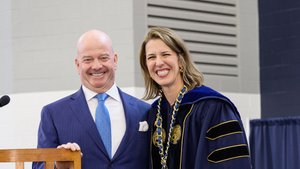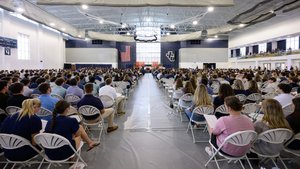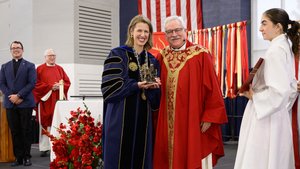
President Carolyn Noll Sorg delivered these remarks during her inauguration as John Carroll University’s 27th president.
Watch the Inauguration Remarks
President Carolyn Noll Sorg delivers her inaugural remarks as the 27th president of John Carroll University.
Good afternoon.
To our students, faculty and staff, Board of Directors, alumni, parents, members of the Society of Jesus, delegates, friends of John Carroll, and colleagues from across higher education: thank you.
And to my family—Brendan, Jackson and Anneliese; my mom, Gail, who is celebrating her birthday today; and the family and friends who have supported us through this remarkable season—thank you. I would not be standing here without you.
It is difficult to describe what it means to stand before you as the 27th president of John Carroll University. It is humbling. It is joyful. And it is an extraordinary privilege.
Last fall, just after I accepted the Board’s invitation to assume this role, I participated in a silent retreat. Its central invitation was simple: Pay attention. Listen. And in that silence, I found myself returning to a question St. Ignatius asked as he realized his old life had ended and an unfamiliar new journey was beginning:
“What new kind of life is this upon which I am entering?”
It’s a remarkable question. It invites us simply to observe. Without drawing conclusions, it asks us to pause and notice what is unfolding before us. And that is harder than it sounds.
Our students arrive at John Carroll at one of the great thresholds of their lives, surrounded by possibility and uncertainty. The world around them is changing quickly. Students, you will enter professions transformed by technologies still being invented. You will confront problems without simple answers. Some of you will do work that does not yet have a name.
We make decisions every day amidst an extraordinary abundance of information. And an equally extraordinary scarcity of attention. We have access to more answers than any generation in human history. And yet we remain hungry for meaning. Because information alone doesn’t tell us what deserves our attention. That is why I believe a John Carroll education is more necessary than ever today.
Education can’t simply be about giving students more information. But rather, teaching them how to pay attention. How to notice before they react. How to listen before they decide. To ask better questions. How to recognize what is true. To examine the assumptions shaping what they see. To honor complexity. And to discover what matters most. For nearly five centuries, Jesuit education has treated that kind of attention as a discipline. Discernment begins with noticing.
“What new kind of life is this upon which I am entering?” The answer here is not a conclusion. Not yet. The answer is more questions. What is happening here? What am I feeling? What am I assuming? What am I missing? Where is there consolation, possibility, tension, or need? Before we can decide where to go, we have to learn to see clearly where we are. And that habit of attention matters in our lives beyond this campus: It also shapes how we encounter other people, and how we cultivate belonging.
My dad could fix almost anything. Throughout my adult life, whenever I was working on something at home, I would call him. He would explain how it worked, what tool I needed, what I should do first. I would listen. And then, inevitably, I would say: “Okay. But what if I did it this way? Could we move this? Use that differently? Take this apart and build something else?” And what I remember most was his reaction. He listened. He considered. He was never rigid or inflexible; he never made me feel foolish for imagining another way. He might say, “Yeah. That could work.” Or, gently flag a safety or quality flaw in my thinking, but build on my idea with his knowledge and we’d make it work – together.
Because he accompanied me, I learned. Because he trusted me, I shared my ideas. His delight in those ideas formed an invitation – to me – to belong. Over the years, in various other scenarios, his confidence in me was so complete that I learned to borrow it until it became my own.
I lost my dad five years ago, on July 31 – the feast day of St. Ignatius Loyola. But he gave me a gift that stays with me every day: confidence. An expectation that my ideas are worth sharing. That I am worthy of belonging in rooms, even as a novice. When someone you trust believes that your way of seeing has value, you become more willing to ask, “What if?” More willing to try. More willing to imagine. More willing to move before you can see the entire path.
That is one of the great powers of belonging. Belonging is more than being welcomed into a community. You know you belong when you believe your presence matters. Your questions matter. Your ideas matter. Even your disagreement matters. And that kind of belonging creates freedom: the freedom to speak, to risk, to reconsider, to imagine—and sometimes to discover that the story you have been telling yourself is incomplete.
That is the kind of belonging we must create at John Carroll. Not belonging that asks us to become more alike. Belonging that gives us enough confidence in our place among one another that we can encounter difference honestly, challenge one another respectfully, confront difficult truths—and remain at the table. Because universities exist to challenge assumptions.
We all carry ideas about how the world works, what success looks like, what others need, who is capable of what, and what is possible. Those mental models help us navigate complexity. But every model is incomplete. Thinking well requires holding our assumptions lightly enough that reality can correct or improve us.
So there we have it: noticing gives us the tools to cultivate belonging. Belonging creates a community that challenges assumptions. That’s how we grow. That’s how we become more than we thought possible.
Notice, belong, and become.
Colleagues, we must notice our students – not the students we remember being but the students sitting here today.
We must notice what’s happening in workplaces across our industries. And honor that their rate of change is often faster than traditional academic structures. We must join our industry partners at the same table, as thought leaders and innovators. Because as we embrace the extraordinary possibilities of technology we must remain clear about our responsibility to form whole humans who can inspire, empathize, communicate, lead, discern, and serve in those workplaces.
And we must notice one another. Who is flourishing? Who feels known? Who feels unseen? Where do our assumptions need to change? Then, we build belonging in moments. A professor learns a student’s name. A colleague invites a dissenting opinion. Someone notices the person standing alone and fixes that. An adviser asks one more question. A supervisor entrusts someone with responsibility before they feel completely ready. An alumnus answers an email from a student they have never met. None of those moments will appear in a strategic plan, but together, they make a university we are proud of.
Our aspiration must be a John Carroll where people belong deeply enough to be brave. Where faculty know their expertise matters. Where staff know their ideas matter. Where students know their questions matter. Where alumni know that they remain part of this community. Where people with different experiences and convictions can enter genuine conversation. And where we are secure in our mission. Belonging is not the end of formation; it creates the conditions for it.
Notice. Belong. Then Become.
Onward. We know it from our fight song: “Onward on, John Carroll.” It signals belonging – to this place and to one another and it is becoming our promise to each other. A promise that – together – we will form a team around every student. That – together – we will help every student create a coherent journey connecting academic learning, experience, mentorship, alumni engagement, and professional development.
Students, this promise invites you to ask curious questions along the way: What am I learning about myself? What gifts do I possess? What does the world need? Where do those things meet? Because this is a university where the liberal arts and professional learning are not treated as competing visions of education. You will need both. We have the capacity to hold both things at the same time.
John Carroll is increasingly becoming known across the country for forming multi-dimensional people who can analyze and empathize, hold convictions and adapt. Lead and serve. We should have national ambition for this university.
Not because prominence is an end in itself but because if we genuinely believe this education transforms lives, then we should want more lives transformed by it.
We will extend our reach. We will create academic experiences responsive to the world our students will enter. We will expand access for talented students from every circumstance. We will ensure that students who begin here flourish and graduate. We will deepen our partnerships in Cleveland and beyond. We will bring alumni more fully into the lives of our students. And we will steward every resource entrusted to us with care and discipline. We will do these things with confidence.
We won’t always have total clarity about our path. I certainly didn’t when I stood in front of half-finished projects with my dad. We knew what we had. We understood as much as we could about the challenge. We had the right tools and then we began asking what might be possible. How we could do it better. That requires imagination, humility, experimentation, and people who believe in and trust one another enough to say: “Yeah, that could work” or “I think there might be a better way.” Because that is what education can do at its best. It can take someone who is uncertain, unfinished and surround them with teachers, mentors, friends, experiences, questions, challenges, and acts of confidence that help them imagine a place they could not see on their own.
Someone says: I see this in you. Try. Ask. Go. I’ll walk with you. And eventually, they begin saying it to themselves. That happened for me. It happened around a kitchen table and in half-finished rooms with a dad who delighted in the way his daughter imagined things. It happened because teachers and mentors invited me into possibilities I had not yet imagined. It happened because communities gave me places to belong and then asked something of me because I belonged there. And it continues to happen. Even now. Especially now. Because becoming president does not mean the questions end. If anything, they become larger.
Our responsibility is not to have every answer today; our responsibility is to pay attention. To listen deeply. To tell the truth about what we see. To challenge our assumptions. To create the conditions in which people belong enough to take risks. To discern together what is worthy of our gifts and then to have the courage to act.
John Carroll, here is where we stand. We stand on nearly 140 years of faith, learning, service, sacrifice, and extraordinary human possibility—and nearly 500 years of a Jesuit, Catholic tradition that gives us our framework. We stand in a world that desperately needs thoughtful people who know not only how to achieve, but how to discern. Not only how to lead, but how to listen. Not only how to answer questions, but how to recognize which questions are worthy of their lives. And somewhere ahead of us is the John Carroll we are still becoming.
We will not reach it through certainty. We will reach it by paying attention to what is before us. By creating a community in which people belong deeply enough to be brave. By remaining imaginative, free, and courageous enough to become what this moment calls us to be.
Notice.
Belong.
Become.
So let us be a university that notices. A university that listens. A university that asks, “What if?” A university that believes deeply enough in its students that they learn to believe in themselves. A university ambitious not merely for its own success, but for the good its graduates can do in the world. And a university that knows enough about who we are to move boldly forward and is free enough to keep discovering who we are called to become.
We know where we stand. We know what guides us. Now, let us imagine what is possible from here.
Onward, Together.