The Arboretum
It isn’t a place within campus. It’s the campus itself.
What is an arboretum?
An arboretum is more than a place with trees. It’s a curated, documented, and intentionally cared-for living collection — a place where every tree has a name, a record, and a steward. Botanical gardens focus broadly on plants; arboreta focus on trees and woody plants, gathered and tended for study, education, and the long, slow work of conservation.
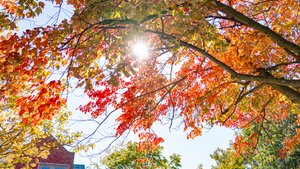
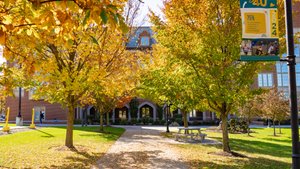
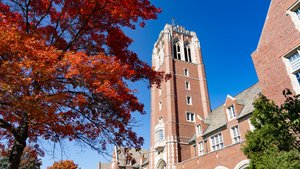
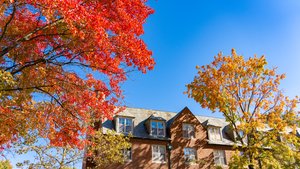
What makes The Arboretum at John Carroll University distinctive is that it isn’t set apart from daily life. There’s no gate, no admission, no separate building. The collection is the campus. The same oaks that shade your walk to class are part of a documented inventory of more than 1,300 trees representing 135+ species. The same prairie plantings you pass on your way to the quad are habitat for native pollinators. Caring for trees and caring for students happen in the same place, at the same time.
Why it matters
Trees are living infrastructure. They cool our buildings, slow stormwater before it floods our streets, clean the air we breathe, and offer measurable benefits to mental health and concentration.
But a documented arboretum does more than what an unmanaged greenspace can do. It preserves species — including some that are increasingly rare in the wild. It supports research and teaching across biology, environmental science, theology, and the arts. It models, in plain sight, what attentive stewardship of a living place looks like over decades.
A Jesuit response to integral ecology
The Arboretum is one of the most visible, walkable expressions of John Carroll’s commitment to integral ecology — the framework Pope Francis introduced in his 2015 encyclical Laudato Si’: On Care for Our Common Home. Integral ecology insists that environmental, social, economic, and spiritual concerns are not separate problems to be solved in isolation. Care for the earth is inseparable from care for one another.
“We must regain the conviction that we need one another, that we have a shared responsibility for others and the world.”
— Pope Francis, Laudato Si’, 2015
In 2022, JCU joined the first cohort of universities to answer this call by becoming a Laudato Si’ campus — committing to a seven-year action plan that touches academics, operations, investment, and community. Establishing The Arboretum is one of the named goals of that plan. It’s how a Jesuit, Catholic university makes the abstract idea of care for our common home something you can walk through, sit beneath, and learn from.
What you’ll find on campus
Beyond the documented tree collection, The Arboretum includes prairie plantings and native gardens that support local pollinators, sustainability features integrated into landscape design, and four self-guided walking routes that introduce 20–30 species at a time. Students, faculty, neighbors, and visitors are welcome to explore from dawn to dusk, seven days a week, year round.
Explore the Collection
Navigate campus tree by tree
Our interactive map lets you explore the full tree collection, filter by species, and follow curated walking routes across campus.
Visit
The campus is freely open to the public from dawn to dusk, seven days a week, at 1 John Carroll Boulevard in University Heights. Use the interactive tree map to follow curated routes, or pull up the campus map to find your way around.
Recognition
Part of JCU’s Laudato Si’ Commitment
Establishing The Arboretum is one of the goals in JCU’s Laudato Si’ Action Plan — the University’s seven-year response to Pope Francis’s call to care for our common home.
Morton Register of Arboreta
Listed in the international Morton Register maintained by The Morton Arboretum, which catalogs arboreta and botanical gardens with a substantial focus on woody plants.
Contact
For questions about the collection, academic partnerships, or community inquiries:
Ed Peck
epeck@jcu.edu · 216-397-4218